
Overtone Captions
overtone.lont.ai
Open-source caption tool that transcribes once and cuts readable captions for every screen shape, from 16:9 to 9:16, in one file.
- Pricing
- Open source
- Published
- Oct 30, 2026
Next steps
What it does
Overtone, made by Lont and released under the MIT license, stores each spoken word once with its timing and speaker in a single .overtone.json file, then cuts captions separately for each picture shape: 16:9 and 9:16 by default, or any aspect ratio you name. Its cuts follow reading rules: lines avoid ending on weak words such as 'the' or 'of', names and numbers stay together, each speaker gets their own caption and pauses become line breaks. A CLI can re-cut subtitles you already have (offline, no API key, no ffmpeg; run npx overtone-captions recut file.srt) and exports horizontal and vertical .vtt/.srt files plus a transcript. It can also transcribe a video from its audio using provider APIs (OpenAI and Azure AI Speech by default, with a --dry-run cost estimate) or fully offline with whisper.cpp and Ollama via --local. A video.js plugin shows the cut that fits the player.
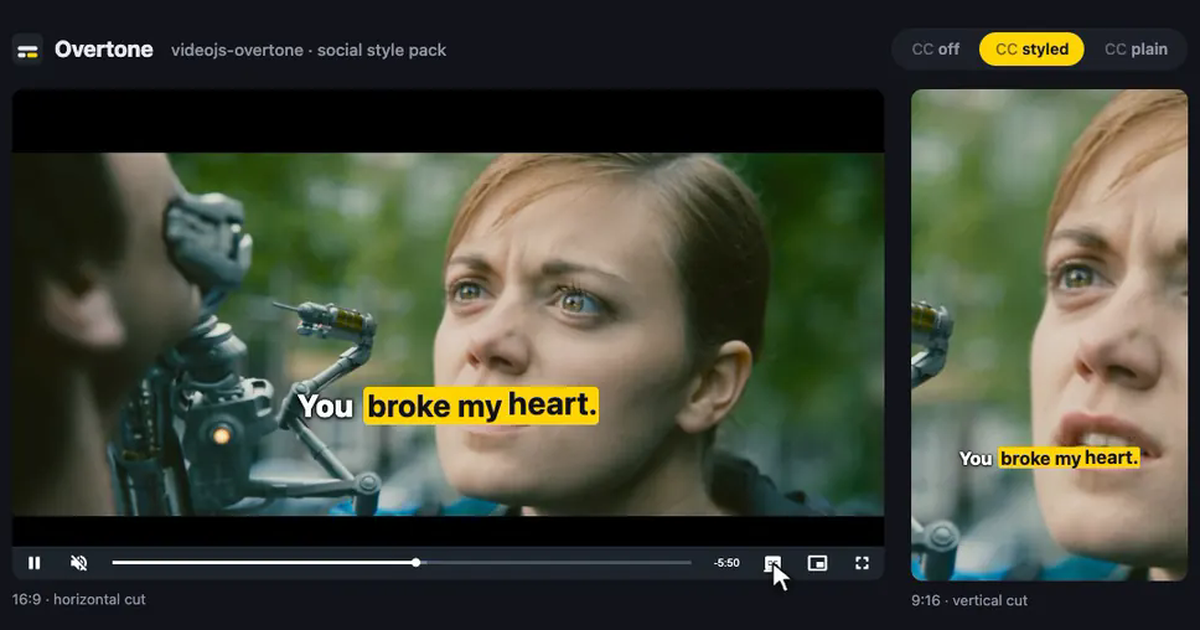
Use cases
- Publish one talk as both a 16:9 YouTube video and a 9:16 short with proper captions
- Re-cut an existing SRT for vertical video without re-transcribing
- Caption videos fully offline with whisper.cpp
Frequently asked questions
- Does Overtone need an API key?
- Not for re-cutting existing subtitles. Transcribing audio uses OpenAI and Azure AI Speech keys by default, or runs offline with --local (whisper.cpp and Ollama).
- What formats does it export?
- An .overtone.json master file plus horizontal and vertical .vtt and .srt files and a transcript.
- Is it free?
- Yes, it is open source under the MIT license.